Research with High School Students
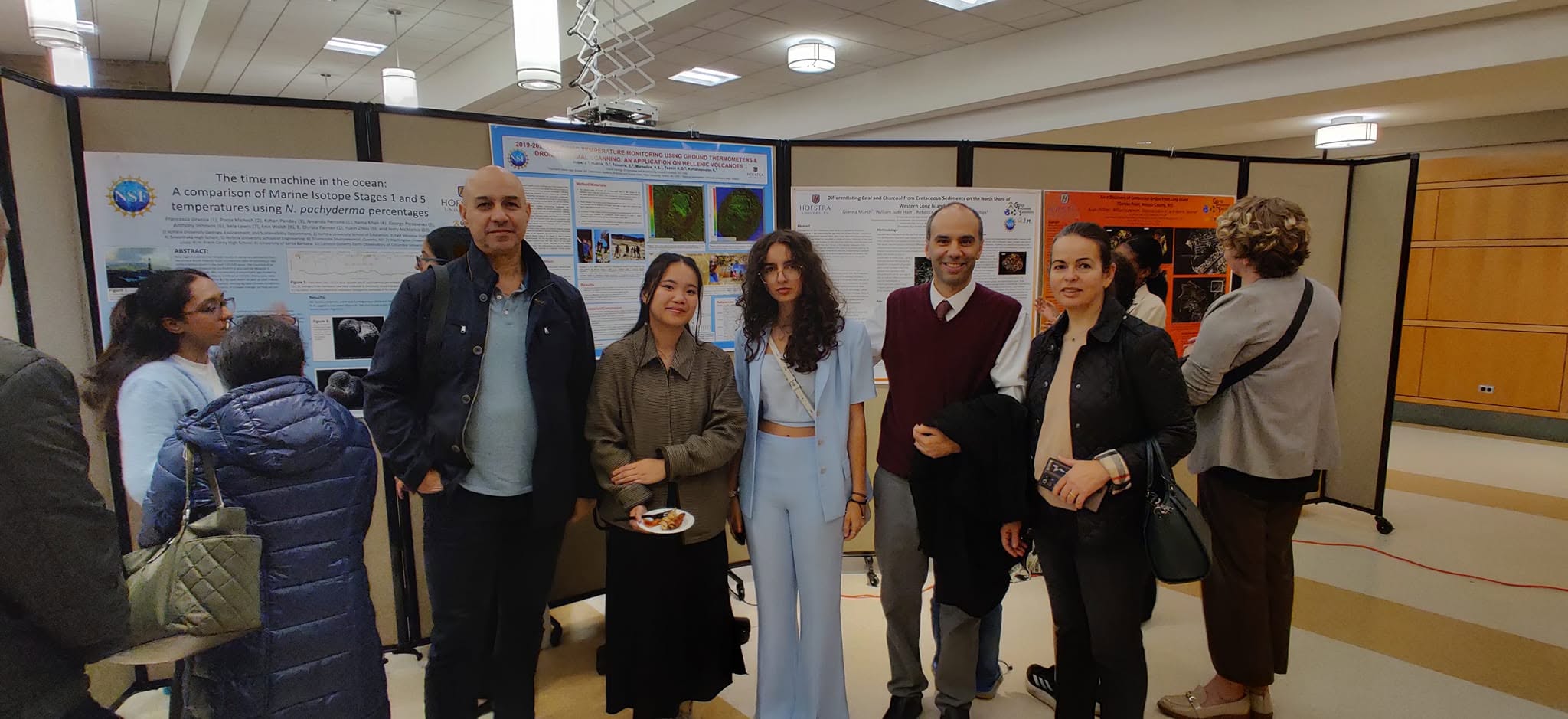
High school students in my group do real research, not simulations of it. I mentor them through the Hofstra University Summer Science Research Program (HUSSRP), a Hofstra program in which students learn R programming from scratch, work with real scientific data, and carry a project from question to conference poster in a single summer, presenting at a Hofstra University conference poster session.
The high school researchers I have mentored:
- Summer 2024: 18 students from schools across the region
- Summer 2025: 27 students, with projects spanning Earth science, climate, geodesy, and biomedical signal analysis
- Summer 2026: 7 students, from New York, New Jersey, California and Indonesia: signal detection and time-series prediction on anesthesia and Alzheimer’s EEG, arrhythmia screening, solar cycles and earthquakes, and GPS filtering; spatial analysis of coastal flooding and satellite shoreline change
- 2021, 2022 and 2023: one high school researcher each year in the NSF-funded GEOTeams program (below), 3 in total
- 55 high school researchers in all, 2021 to 2026
- Selected projects continue to external venues, including the ISEF-affiliated Long Island Science and Engineering Fair and a peer-reviewed IEEE International Conference on Healthcare Informatics (ICHI 2026) paper
How the summer work runs
The students I mentor meet with me online through the summer, learning data analysis in R while developing an individual research topic with real datasets: EEG recordings from pediatric seizure patients, continuous GPS displacement, sunspot records, sea-level and groundwater time series, and more. The summer ends with a printed research poster presented at Hofstra University.
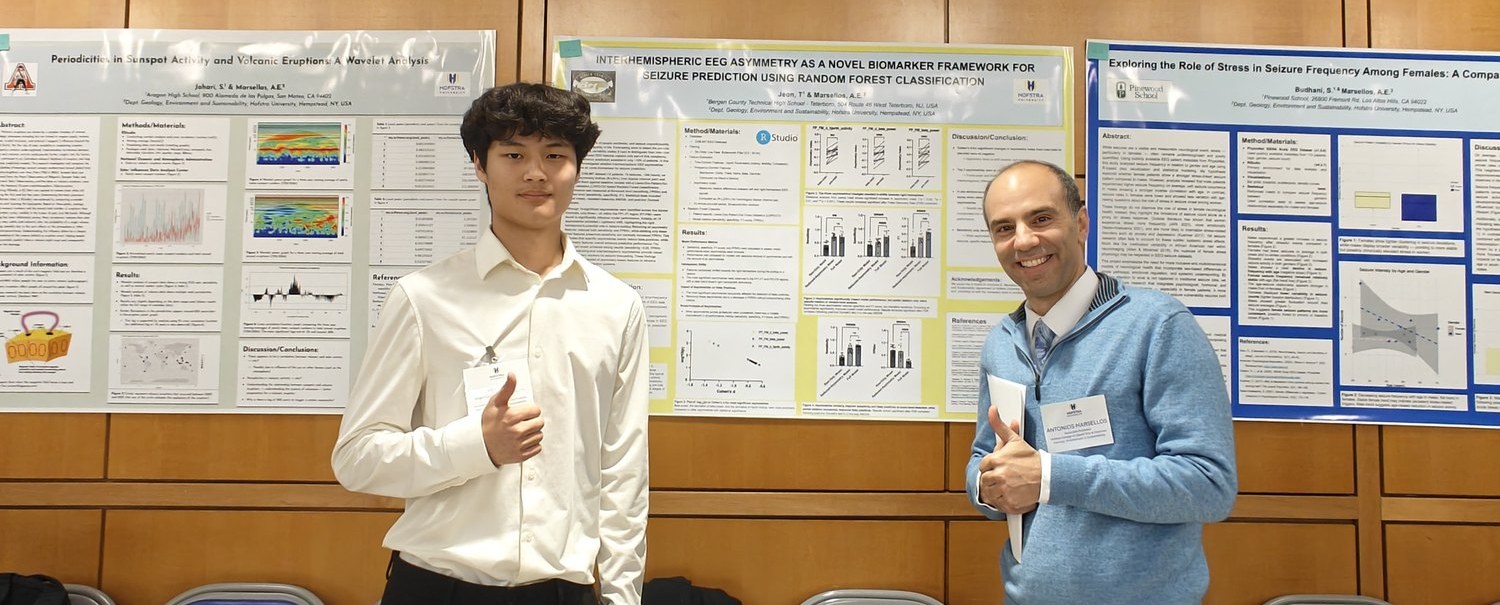
The methodology my students learn mirrors the group’s research toolkit (time-series decomposition, wavelet analysis, artificial neural networks) and the beginner-first approach of my book R for Earth and Sustainability Data Analytics.
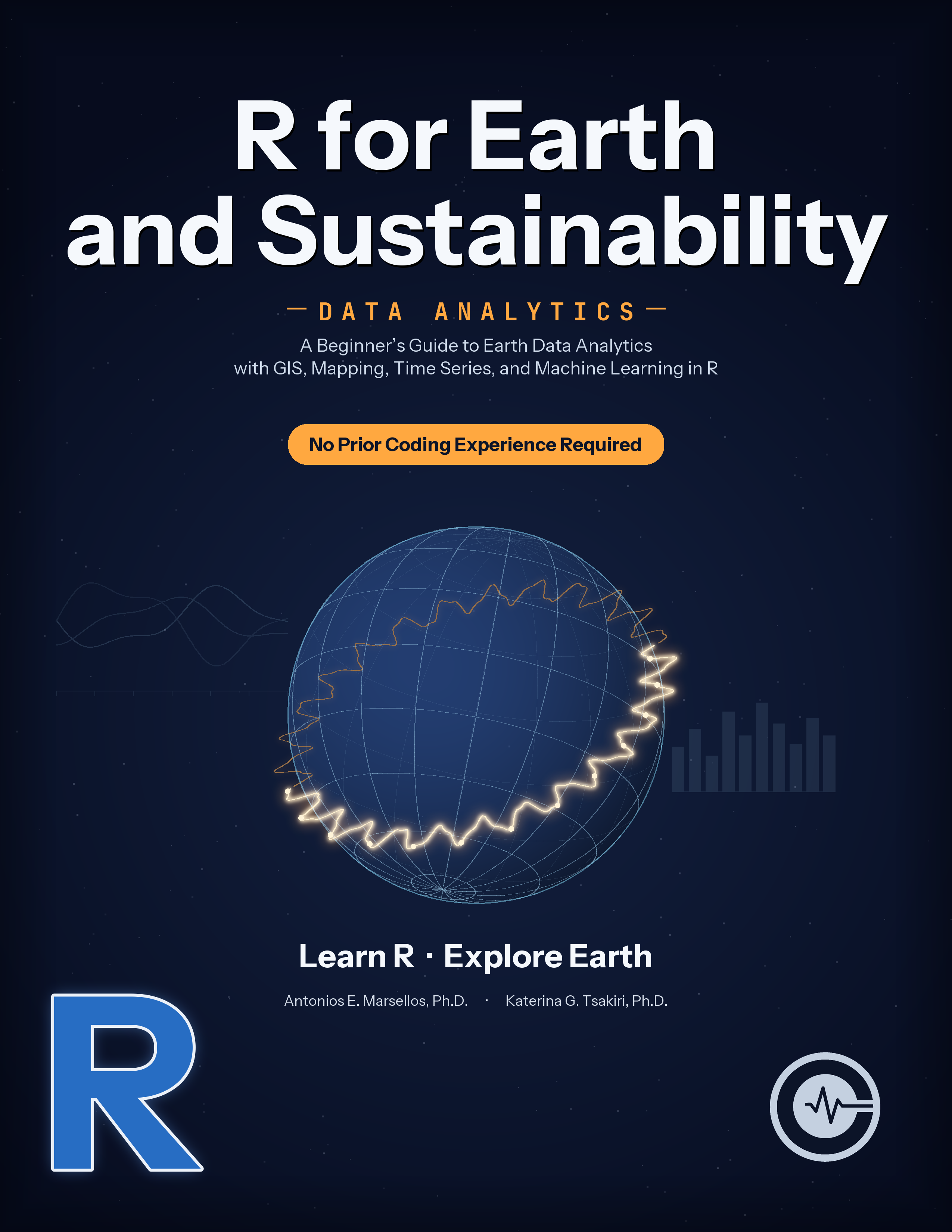
The book behind this work
R for Earth and Sustainability Data Analytics follows the same beginner-first path the students take: no prior coding or statistics experience assumed, working with real Earth and environmental data in R. It is recommended reading for the students I mentor, never required, and the opening chapter and the quick-start cheat sheet are free.
Free chapter 1 (PDF) Free cheat sheet (PDF) Get it on Amazon About the book →
A separate program: NSF GEOTeams (2021–2023)
HUSSRP is not the only route high school students have taken into this group. GEOTeams was a separate program, with separate funding, supported by the NSF (award #1911514), on which I was a co-principal investigator. It built multilevel research teams: a faculty mentor, Hofstra undergraduates, and one high school researcher working together on the same scientific question rather than on separate exercises.
One high school researcher joined the team in each of the three years. Each carried the work through to a conference presentation and appears as a co-author on it:
- Kayla C. Elliott (2021), South Side High School, Rockville Centre, NY: baseline activity of the low-temperature Thera volcano at Santorini, separating out the atmospheric influences
- Georgia Tentomas (2022), Holy Cross High School: the effect of sunspot number on climate change and on water sustainability in Long Island, New York. She went on to Stanford University, Department of Earth Sciences
- Eleni Tsiouris (2023), Townsend Harris High School: five years of volcanic temperature monitoring with ground thermometers and drone thermal scanning on the Hellenic volcanoes. She joined the NSF-funded international field trip to the active volcanoes of Greece
HUSSRP, in which I serve as a research mentor, has continued this work since 2024 as a distinct university program under separate funding.
Research highlight
A HUSSRP project on filtering electroencephalogram (EEG) data was published as a peer-reviewed paper at IEEE ICHI 2026, a professional healthcare-informatics venue:
Pasumarthi, S., Marsellos, A.E., 2026. Filtering Electroencephalogram Data Using R: A Study on Patients with Seizures. 2026 IEEE 14th International Conference on Healthcare Informatics (ICHI), Minneapolis, MN, USA, June 1–3, 2026, p. 1317–1318. IEEE. doi:10.1109/ICHI69079.2026.00274
Posters & papers by high school students
Every poster below was researched, written, and presented by a high school student in the group. Click poster to open the full PDF.
Two of the 2026 projects can also be watched as short clips, re-run in R from the students’ own data: Student Research, Made in R and Python.
Loading…
Interested in joining?
HUSSRP applications are handled through Hofstra University’s Summer Science Research Program, where eligibility, dates, and the application form are posted. You can reach me at antonios.marsellos@hofstra.edu to discuss project ideas in Earth science, data analytics, or biomedical signal analysis.